



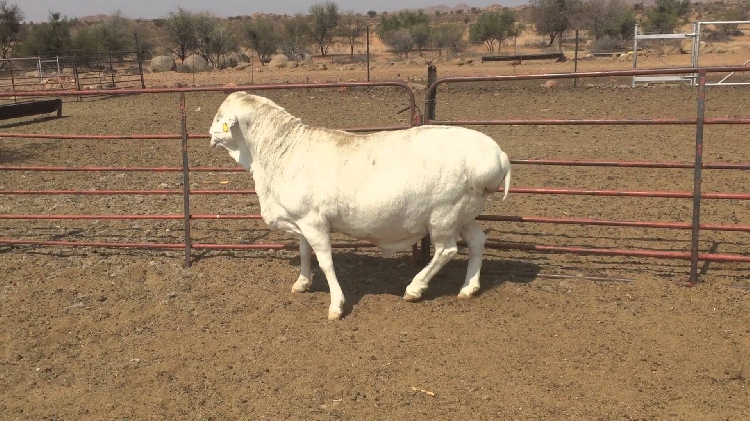
THE Van Rooy, also known as the Van Rooy white Persian, is a breed of domestic sheep native to South Africa.
The breed was first developed in 1906 by (and named for) JC van Rooy, a South African farmer in the Bethulie district.
It is a cross between indigenous Ronderib Afrikaner sheep and Rambouillets. It is a fat-tailed and hair sheep generally kept for meat production, and is very well-suited to arid climates.
Van Rooys are polled, have drooping ears, and are entirely white. The breed is relatively rare, even in South Africa, but has also been exported to Namibia and Zimbabwe. JC van Rooy set three requirements for this breed. It had to:
• Be strong and hardy to cope with regular droughts;
• Be fertile in order to maintain a high percentage of production;
• Have an excellent conformation.
With these aims in mind, Van Rooy made use of a white Blinkhaar Afrikaner ram and Rambouillet ewes. In-breeding coupled with severe selection was applied to the progeny. Selection was aimed mainly at size, conformation and white sheep with enough wool in between the bristly hair to serve as protection against cold. Later on, a polled Wensleydale ram was introduced in an effort to improve conformation. These important characteristics have been preserved and present-day breeding and selection keep them in mind.
Description
The Van Rooy is a medium- to large-framed sheep and both rams and ewes are polled. The sheep has a characteristic dewlap from the jaw to the brisket and a very prominent chest and brisket. The breed is covered with strong white hair. The upper part of the body must have a woolly mixture. On the head, legs and lower parts of the body the hair is short and devoid of wool.
The tail is characteristically fat-rumped and consists of two parts – the main upper part and the switch. The main portion should be broad and firm, and affixed as high as possible. It is oval towards the rear with a slight upward tilt at the end from which the switch hangs down vertically. The switch is smooth with short hair and no wool. The size of the tail should be well in proportion with the rest of the sheep.
Production norms
Van Rooy ewes can be mated throughout the year and are ideally suited for accelerated lambing systems. The sheep prefer arid to semi-arid savannah. The skin makes good glove leather. Van Rooy rams are widely used to produce cross-bred lambs, which put on fat on the carcass at a much earlier stage than when cross breeding two non-fat-tailed breeds. –
In an age of information overload, Sunrise is The Namibian’s morning briefing, delivered at 6h00 from Monday to Friday. It offers a curated rundown of the most important stories from the past 24 hours – occasionally with a light, witty touch. It’s an essential way to stay informed. Subscribe and join our newsletter community.

The Namibian uses AI tools to assist with improved quality, accuracy and efficiency, while maintaining editorial oversight and journalistic integrity.
Stay informed with The Namibian – your source for credible journalism. Get in-depth reporting and opinions for
only N$85 a month. Invest in journalism, invest in democracy –
Subscribe Now!