


The Day of the African Child has been celebrated on 16 June every year since 1991, when it was first initiated by the Organisation of African Unity.
It honours those who participated in the Soweto Uprising in 1976 on that day. It also raises awareness of the continuing need for improvement of the education provided to African children.
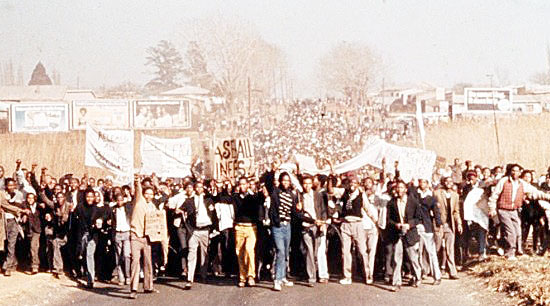
In Soweto, South Africa, on 16 June 1976, between 10 000 and 20 000 black school children marched in a column more than half a mile long.
The students protested against the Afrikaans Medium Decree of 1974, which forced all black schools to use Afrikaans and English in a 50–50 mix as languages of instruction.
The Regional Director of Bantu Education (Northern Transvaal Region), told Circuit Inspectors and Principals of Schools that from
1 January 1975, Afrikaans had to be used for mathematics, arithmetic, and social studies from standard five (Grade 7), according to the Afrikaans Medium Decree; English would be the medium of instruction for general science and practical subjects (homecraft, needlework, woodwork, metalwork, art, agricultural science). Indigenous languages would only be used for religion instruction, music, and physical culture.
On the morning of 16 June 1976, the students walked from their schools to Orlando Stadium. Many students who later participated in the protest arrived at school that morning without prior knowledge of the protest, yet agreed to become involved. The protest was planned by the Soweto Students’ Representative Council’s (SSRC) Action Committee, with support from the wider Black Consciousness Movement. Teachers in Soweto also supported the march after the Action Committee emphasised good discipline and peaceful action.
Tsietsi Mashinini led students from Morris Isaacson High School to join up with others who walked from Naledi High School. The students began the march only to find out that police had barricaded the road along their intended route. The leader of the action committee asked the crowd not to provoke the police and the march continued on another route, eventually ending up near Orlando High School.
The crowd students made their way towards the area of the school. They sang and waved placards with slogans such as ‘Down with Afrikaans’, ‘Viva Azania’ and ‘If we must do Afrikaans, Vorster must do Zulu’.
According to sources, some of the children started throwing stones as soon as they spotted the police patrol, while others continued to march peacefully. Colonel Kleingeld drew his handgun and fired a shot, causing panic and chaos. Students started screaming and running and more gunshots were fired.
The police let their dogs loose on the protesters, who responded by stoning the dogs to death. The police then began to shoot directly at the children.
One of the first students to be shot dead was 13-year-old Hector Pieterson. He was shot at Orlando West High School and became the symbol of the Soweto uprising. The police attacks on the demonstrators continued and 23 people died on the first day in Soweto.
The violence escalated, as bottle stores and beer halls seen as outposts of the apartheid government were targeted, as were the official outposts of the state.
The violence abated by nightfall. Police vans and armoured vehicles patrolled the streets throughout the night.
Emergency clinics were swamped with injured and bloody children. The police requested that the hospital provide a list of all victims with bullet wounds. The hospital administrator passed this request to the doctors, but the doctors refused to create the list. Doctors recorded bullet wounds as abscesses.
The 1 500 heavily armed police officers deployed to Soweto on 17 June carried weapons including automatic rifles, stun guns, and carbines.
They drove around in armoured vehicles with helicopters monitoring the area from the sky. The South African Army was also ordered on standby as a tactical measure to show military force. Crowd control methods used by South African police at the time included mainly dispersement techniques.
Today and every year on 16 June, governments, NGOs, international organisations and other stakeholders gather to discuss the challenges and opportunities facing the full realisation of the rights of children in Africa.
In an age of information overload, Sunrise is The Namibian’s morning briefing, delivered at 6h00 from Monday to Friday. It offers a curated rundown of the most important stories from the past 24 hours – occasionally with a light, witty touch. It’s an essential way to stay informed. Subscribe and join our newsletter community.

The Namibian uses AI tools to assist with improved quality, accuracy and efficiency, while maintaining editorial oversight and journalistic integrity.
Stay informed with The Namibian – your source for credible journalism. Get in-depth reporting and opinions for
only N$85 a month. Invest in journalism, invest in democracy –
Subscribe Now!