


AT 03h45, Sophia January’s cellphone alarm goes off for the third time, and she takes it from under the pillow to switch it off.
I am with her because I need to walk through her day with her, and this meant sleeping in the shack with her brother’s two-year-old son.
Sophia has two adult children – a daughter (31) and a son (18). Her daughter, she says, is a hearing and speech-impaired child, while her son recently failed Grade 10.
It’s warm in the shack, where a kitchen cupboard divides the space in two. A dressing table sits on the other side. Outside, Otjomuise extension 2 is quiet and dark.
Sophia (51) moved here from Malaka Draai in Damara location, Katutura, after her employers had bought her the corrugated iron sheets for N$500 to build the shack.
This, she says, is a better option than paying a lot of money while staying in somebody else’s shack. As it is, Sophia says, she pays N$750 for the land and another N$250 for electricity.
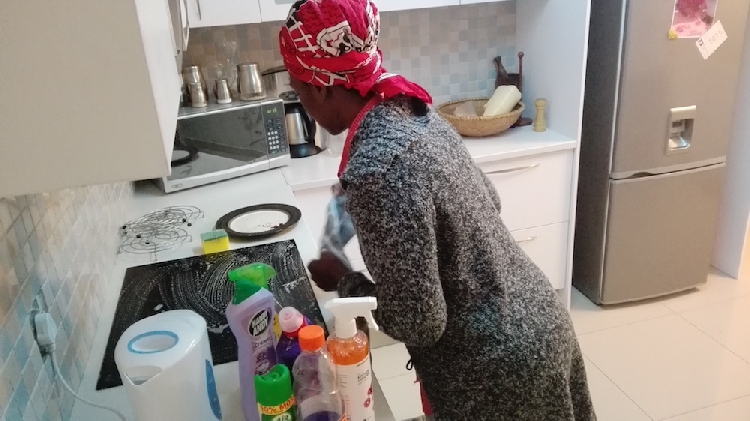
Sophia, who has been a domestic worker since being a teenager, works in Cimbebasia, and sometimes takes on extra jobs to supplement her salary.
Although her workday, from Monday to Saturday, usually runs from 07h30 to 17h00, she at times works until 22h00 when doing extra jobs. She earns N$2 700 a month, which she says barely covers the necessities for the two of them.
While Sophia had already been awake when the alarm went off, I only stirred with the fourth alarm ring. Sophia is applying lotion while sitting on the bed.
Probably noticing that I was looking at the rough floor, Sophia tells me that she wants to make her shack more homely with money saved to buy at least three bags of cement. I also get up to wash my face and brush my teeth, using water from a jug. There are no toilets in this part of Otjomuise, so people use the nearby bushes.
When the alarm goes off again at 04h15, Sophia’s nephew, who attends a nearby kindergarten, is awaken. Sophia has to drop him off before taking the bus.
There is no time to bath the boy. Sophia, however, packs some clothes in the backpack, and leads the boy out in his pyjamas. The teacher, Sophia says, will dress him later.
The kindergarten is about 100 metres away. It is an ordinary shack where children are looked after while their parents or guardians are at work.
Her son, Sophia says on the way over, pitied her, and said he would rather get a job and look after himself.
She says she wanted to enrol her daughter in a special needs school, but was informed that there was no space available.
“So, we later gave up,” she says, adding that her daughter lived with her boyfriend on a farm.
Although the kindergarten starts at 07h00, the owner is already up and about, and takes the boy off Sophia’s hands. Sophia can collect him any time between 17h00 and 23h00.
So, we set off for the bus stop. It’s still dark outside, and the path we take to the nearest street is rocky and rough. After stumbling a few times, I decide to take out my phone for some light.
Just as I am unlocking it, Sophia whispers to me to put the phone away because the light may attract criminals hiding in the bushes.
“It is better to fall than to lose your possessions. We walk through these valleys in prayers, my girl,” she says, walking a bit faster.
It takes us less than 10 minutes to get to a gravelly street, where there are at least street lights. Another 100 metres along, we reach a tarred road and more street lights.
Sophia, who is walking faster, complains about the grass on the roadside that has been left to grow. She says there is a woman who walks through the tall grass to get to the bus stop.
“The municipality must clean this area for us. It is just too dangerous,” she says.
We get to the bus stop in Otjomuise extension 1 around 05h00, and more women join us. They are quietly talking and laughing.
Sophia engages other women in conversation about happenings over the weekend.
The bus finally arrives, and we hop on. Most of the women greet the driver cheerfully before taking their seats. There are four stops before we leave for Cimbebasia. By now, the bus is full to capacity, and some people stand in the aisle.
The bus arrives in Cimbebasia around 06h30, and because many of them are only expected at their employers’ houses from 07h30, some of the women loiter at the bus stop. Sophia bids them goodbye, and walks up the street with five other women.
“We sit by the shop until 07h30,” she says, referring to an old Cimbebasia supermarket.
I also bid her goodbye to prepare for work and check on Sophia later, around 08h30.
In an age of information overload, Sunrise is The Namibian’s morning briefing, delivered at 6h00 from Monday to Friday. It offers a curated rundown of the most important stories from the past 24 hours – occasionally with a light, witty touch. It’s an essential way to stay informed. Subscribe and join our newsletter community.

The Namibian uses AI tools to assist with improved quality, accuracy and efficiency, while maintaining editorial oversight and journalistic integrity.
Stay informed with The Namibian – your source for credible journalism. Get in-depth reporting and opinions for
only N$85 a month. Invest in journalism, invest in democracy –
Subscribe Now!