



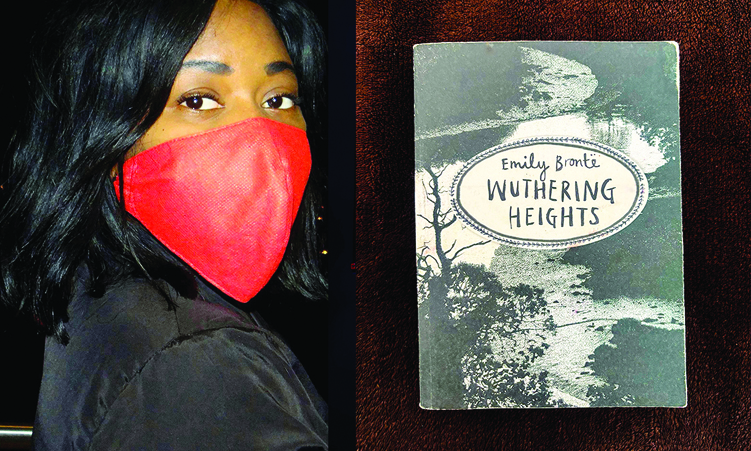
There’s a scene at the beginning of ‘Wuthering Heights’– the book, not the recent movie – where the ghost of Catherine Linton begs to be let into her former home. It’s the kind of gothic, deeply disturbing moment that had me nervous about watching the new film alone.
With the decline of cinema in full swing, being the sole patron in a dim theatre is likely. But after rereading a book I last experienced in high school, I settle into my cinema seat relieved to perceive two other moviegoers in the dark.
If you’ve watched Emerald Fennell’s recent film adaptation, you know I need not have worried because the nightmare scene is entirely absent. In fact, the latest rendition of Emily Brontë’s timeless novel dispenses with much of the book’s darker and supernatural elements.
Instead, moviegoers are immersed in a bright, Bridgerton-esque interpretation that leans into the steamy, romance novel trends that seem to have everyone by the throat. Consensually, of course.
If you’re a purist looking for a faithful adaptation of Catherine and Heathcliff’s destructive, often sadistic but seemingly chaste and tragic love story, you’re going to be pissed. Fennell’s screen adaptation pointedly puts “Wuthering Heights” in quotation marks for multiple reasons.
Perhaps chief among them, is that there’s a tad more sex than you’ll recall from the novel. The servants are at it. Catherine is handling herself on the moors. It’s happening in gardens, on windswept plains and in carriages. It’s alluded to in scenes of baking, snails and jellied fish which is a far cry from the sexless source material.
Like Brontë’s novel, Fennell’s film is a product of its time. And, right now, many people seem to want to trade dystopian, warring reality for historically inaccurate period dramas with a liberal smattering of smut.
Call it a sign of the times, but would I call the film good?
As someone who reread the book immediately before watching the recent adaptation, the film left a lot to be desired.
In Brontë’s book, just about everyone is kind of awful. A number of her characters, especially Heathcliff, are selfish, vengeful and violent and there is a supernatural element that looms over it all in a way that is fascinating and thoroughly unsettling.
In Fennell’s film adaptation, Heathcliff in particular is highly sanitised.
The sadistic, vindictive, obsessive and abusive character of the novel is reimagined as a yearning, hot-tempered young man whose love for Catherine is all-consuming. Catherine’s love for Heathcliff in both the book and movie is similarly obsessive. But what’s missing is a sense of Heathcliff being deeply outcast beyond issues of class.
In Brontë’s novel, Heathcliff is othered because of the dark colour of his skin, because Catherine’s father essentially adopted him off the street, and because of his unknown pedigree, boorish nature and illiteracy.
In Fennell’s ‘Wuthering Heights’ Heathcliff is white and many of his edges are smoothed out. This includes his abuse of Isabella Linton, whose exploitation and ill-treatment Fennell decides to reframe as some sort of fetish or sexual kink.
If you’ve read the book, Isabella’s reimagining may be particularly jarring as she is, in the end, a domestic abuse survivor who tries her utmost to save herself and her child from Heathcliff’s cruelty. So, one could see her comic, sexualised and diminished retooling as particularly disappointing.
Much has and will be written about the differences between the book and the recent movie, about the framing, the whitewashing, sanitising and the characters who are disappeared or amalgamated, which make for some odd narrative arcs and some unconvincing motivations.
But, going into the film adaptation, it did me well to bear in mind that adaptations are just that.
They adapt to the sensibilities and tastes of the time. They change things. They include music and stylish costumes and make the most of the medium while adding the visual and tonal signature of the adapting artist, for better or for worse.
Whether Fennell’s ‘Wuthering Heights’ is a good film is a question I’ll leave you to answer yourself.
The film is now showing at local cinemas.
Tickets are half-price on Tuesdays and there are no ghosts, so you can go alone.
– martha@namibian.com.na; Martha Mukaiwa on Twitter and Instagram; marthamukaiwa.com
In an age of information overload, Sunrise is The Namibian’s morning briefing, delivered at 6h00 from Monday to Friday. It offers a curated rundown of the most important stories from the past 24 hours – occasionally with a light, witty touch. It’s an essential way to stay informed. Subscribe and join our newsletter community.

The Namibian uses AI tools to assist with improved quality, accuracy and efficiency, while maintaining editorial oversight and journalistic integrity.
Stay informed with The Namibian – your source for credible journalism. Get in-depth reporting and opinions for
only N$85 a month. Invest in journalism, invest in democracy –
Subscribe Now!