


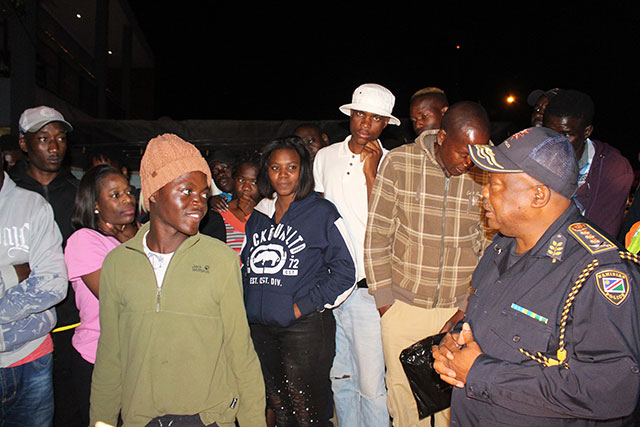
Ruth Kamwi of accompanied the ‘Operation Kalahari Desert’ team on a cold Wednesday evening as they embark on another patrol on the streets of Katutura.
IT’S AROUND 18h00 last Wednesday. I have exactly an hour to decide whether I’ll go on patrol with the ‘Operation Kalahari Desert’ team.
The idea is mind-blowing; it’s surreal. The operation has come under heavy scrutiny. Not knowing what to expect, prompts some reservations. I take the chance anyway because, hopefully, it will help me better understand what law-enforcement officers do in their line of duty.
A few minutes before 19h00, I make my way to the scheduled point of assembly, the City Police headquarters, where the media is to meet officers affiliated with the operation.
I am not familiar with the place. The taxi driver who takes me there is understanding enough, though. However, he does not stop asking why I am going there. I tell him I’m visiting a friend, and specify that the friend is a woman.
He obviously does not buy into it. If anything, this explanation further deepens his suspense. He suggests I am going to report a violent spouse, an occurrence that still contaminates many relationships.
Finally, we arrive at the City Police, and as I pay him the fare, he grins in a mischievous, ‘knowing’ manner.
I am one of the first to get there. Seeing some familiar faces, both from the media and the police, puts me at ease.
We exchange sturdy handshakes as we await the arrival of safety and security deputy minister Daniel Kashikola and police inspector general Sebastian Ndeitunga.
The deputy minister comes across as a stern figure, one on whose wrong side I do not wish to find myself.
We head into the building, where we are briefed on the evening’s plan.
A flight of stairs up is a boardroom, which is largely occupied by a huge lightwood boardroom table surrounded by about 16 maroon leather chairs which have gold nail head trims. On display are various framed police badges and certificates in praise of police work.
I can also see mugshots of criminals plastered on the room’s wall. In one of the mugshots, a man sporting a white vest with black lettering strikes a pose with a gun in either hand. He does not appear to be older than 40 years.
Top law enforcers sit around the large table. Other officials and journalists sit on extra chairs placed along the walls. Introductions follow. Tonight is an appraisal of ‘Operation Kalahari Desert’.
Among those who are to join the patrol is Moses Garoëb constituency councillor Martin David, one ‘councillor Ikela’, and a businessman who pledged to financially contribute to the operation’s needs.
A policeman takes us through a presentation, baton in hand – the kind of scenario which takes me back to my primary school days, when a certain revered teacher would conduct her lessons with a stick in hand.
“This will be a short briefing before we go into the field so that one can understand how we normally do our operations,” the officer says.
He gives a breakdown of the operation’s members. There are 260 members, whose work is split into four shifts on a 24/7 basis.
The Namibian Police – which leads the operation – has 133 members, the Namibian Defence Force component is 78, the City Police have 18, and the Namibian Correctional Services number 31.
An obstacle, the police officer says, is a shortage of vehicles.
The presentation looks at the operation’s focus, including areas of concern – the most notorious hot spots, the most common crimes, and a plan of action.
These areas of concern determine where operation members will be deployed.
Crime is notably rife in high-density areas, the officer says, citing especially cases of assault.
Another concern in highly populated areas is cellphone grabbing, aggravated by victims being reluctant to open cases after their cellphones have been recovered, the policeman notes.
In lower density areas, like Klein Windhoek, housebreakings and robberies are common. Robberies mostly involve students who are robbed when they use public transport.
After the serious tone of the briefing, the boardroom is filled with bursts of laughter when the officer raises the issue of people who claim to have been robbed when in fact they have been pounced on by unsparing thieves while partaking in romantic rendezvous at ungodly hours.
We are then taken to the CCTV room, but are asked not to publish visuals of its set-up.
Here, we watch a recording of an elderly German tourist couple who are robbed while sightseeing in the capital. Literal daylight robbery, methinks.
One of the robbers sports a balaclava, which shields his face from the CCTV cameras.
In an age of information overload, Sunrise is The Namibian’s morning briefing, delivered at 6h00 from Monday to Friday. It offers a curated rundown of the most important stories from the past 24 hours – occasionally with a light, witty touch. It’s an essential way to stay informed. Subscribe and join our newsletter community.

The Namibian uses AI tools to assist with improved quality, accuracy and efficiency, while maintaining editorial oversight and journalistic integrity.
Stay informed with The Namibian – your source for credible journalism. Get in-depth reporting and opinions for
only N$85 a month. Invest in journalism, invest in democracy –
Subscribe Now!