


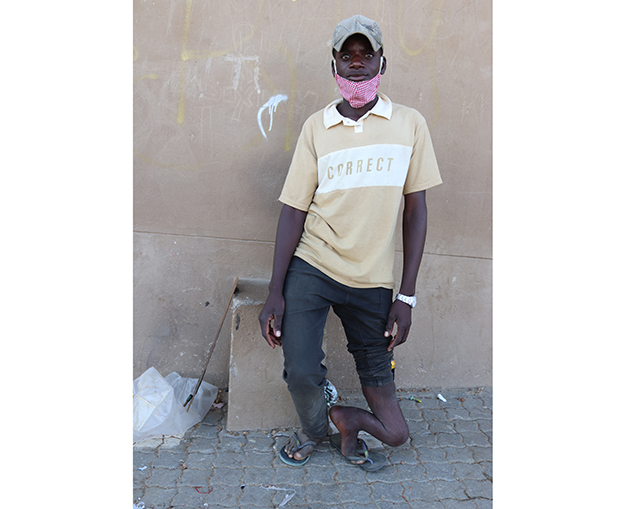
THE first time The Namibian met Yevari Angula, he was refusing to move from outside the shop he sells his sausages and sweets in the Havana informal settlement in Windhoek.
The management of the shopping centre from where he sells his wares deem him an illegal trader and wanted him off the property.
So when this newspaper approached him, Angula was reluctant to speak about his ordeal.
Angula (24), who walks with difficulty because of an injured leg, finally asked if The Namibian had also come to chase him away. However, The Namibian was curious about his limp and deformed leg. He was relieved to know that the interview was about his leg instead.
“Okay . . . because I am not planning to leave this place until I sell everything and reach my target for the day. They [management] can see I am disabled, where do they want me to sell?” Angula said.
Angula was born and grew up in the Endola constituency in Ohangwena region. He never attended school.
Asked what happened to his leg, he explained that he was not born with a disability.
He answered the question while keeping an eye on the manager of the shop from where he sells his wares.
“I was not born this way, I broke my leg when I was 10 years old, we were herding cattle in the field when an older boy threw a tree stump to stop a cow from straying but instead it hit me on the left lower part of the leg and it broke. I still remember that pain because I have had to live with it till now,” explained Angula.
He added that when they returned home, his leg was wrapped with a piece of cloth. He was given traditional medicine for the pain as the hospital was too far.
“I was in so much pain I could not move for months, I still can’t believe I made it and still wonder how I pulled through with the pain. Until now, I experience the pain, especially when it rains, but I have learned to live with it,” Angula said, while sipping an energy drink.
According to Donald Matukane, a orthopeadic surgeon at Ongwediva Medipark, a broken leg happens when one of the bones in the leg cracks. It is also referred to as a leg fracture.
He, however, said he did not examine Angula but The Namibian narrated his ordeal to Matukane, and sent him pictures.
“He has a severe flexion of the knee bending and tibial deformity (shin bone). He will need to be examined to see if it is possible to correct the deformity, X-rays of the lower limb, angiogram to check the blood supply,” he said, adding that the blood supply monitoring should be done before any intervention.
He further added that at the time of injury, an X-ray should have been done to asses the severity of the injury, and the type of treatment could be decided upon surgical intervention or non-surgical operation.
According to a health site called Healthline, there are three types of bones in the leg. These are the fibula, which is the smaller of the two bones below the knee. It is also called the calf bone. The tibia is the larger of the two bones below the knee. The femur is the bone above the knee. It is also called the thigh bone or the shin bone.
“The fibula helps to stabilise and support your leg, body, ankle, and leg muscles. It runs parallel to the tibia, a larger bone that also forms the shin, and attaches the ankle and knee joint.
The fibula only carries 17% of the body’s weight. A fibula fracture happens when more pressure is put on the bone than it can handle. Angula, however told The Namibian that after his bone broke, he could not walk so he would use a stick to maintain balance.
“The leg was swollen and at times it bled, it was not easy, it was painful. I really don’t know how to explain that pain,” he said, adding that it only got better when he was about 14.
Angula disclosed that he only got medical attention for the leg when he was 12, but was told it was too late to restore it so since then, he has only been receiving pain killers whenever he goes to the hospital.
Healthline says the general process for healing a fibula fracture is immobilisation with a splint or cast of plaster for several weeks, after which the patient might get a walking boot to help with mobility.
“Recovery time depends on factors such as the severity of the injury and the presence of any other injury; your age; and how well you can follow your doctor’s orders; whether or not you require surgery; the amount of time spent on physical therapy; and any other underlying conditions that may affect the healing,” says Healthline.
Meanwhile, Dr Matukane said that surgery carries a high risk of blood vessel and nerve injury because the structures cannot be stretched too quickly and too much..
“If correction and lengthening is to be done, highly specialised equipment is used, but it must be made clear to the patient the risk the procedure carries. One of the complications may include leg amputations,” Matukane explains.
In an age of information overload, Sunrise is The Namibian’s morning briefing, delivered at 6h00 from Monday to Friday. It offers a curated rundown of the most important stories from the past 24 hours – occasionally with a light, witty touch. It’s an essential way to stay informed. Subscribe and join our newsletter community.

The Namibian uses AI tools to assist with improved quality, accuracy and efficiency, while maintaining editorial oversight and journalistic integrity.
Stay informed with The Namibian – your source for credible journalism. Get in-depth reporting and opinions for
only N$85 a month. Invest in journalism, invest in democracy –
Subscribe Now!