



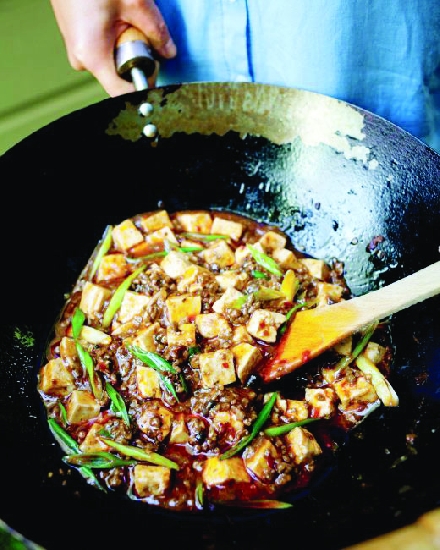
It took me exactly 45 years and 326 days to decide that I like tofu. Like it enough to want to know more about it, at least. I do have moderate feelings of shame about my ignorance since the humble bean curd has been around for more than 2000 years.
Any food that has been around for that long deserves our serious attention, don’t you think?
Quite a few years ago, I entertained two colleagues from South Africa. In true Namibian fashion, I fed them meat and very little else. For almost a fortnight, I planned each meal with meticulous precision and a plate of rohhack brötchen close at hand.
One particularly balmy evening, I lifted two whole oryx sirloin and held them above my head. One was wrapped in prime smoked bacon, the other basted in Spanish olive oil and lemon. How proud I was as I stood there, draped in sirloin the size of two young pythons.
How impressed they were. For a moment, I thought the elder of the two was going to burst into tears. He asked to touch the meat. I let him. Then he smelled it. Touched it again. Shook his head, and smiled. It was clear that he enjoyed the spectacle. As it turned out, his vegetarian wife had taken control of his diet, declared red meat ‘necessary collateral damage’, and started serving him tofu. Lots of it, and very frequently.
As you can very well imagine, two slabs of firm tofu pulled from a glass jar with milky water does not have quite the same sex appeal as two whole oryx sirloin sizzling over hot coals. For us Namibians, anyway.
In case you did not know, fresh tofu is tasteless and odourless. Its texture is determined by how it is made, what coagulant is used, if and for how long it is pressed and whether it is processed and fermented after pressed.
I wanted to experience the tofu making process first hand, so I visited one of the local tofu makers in Windhoek’s China Town.
In essence, tofu is a curd made from dry soybeans. First, the dry beans are soaked in water overnight. Then they are strained, ground and additional water is added. During the grinding process, the liquid, now called soy milk, is separated from the ground bean solids. The solids are passed through the grinder once more to extract as much soy milk as possible. Once done, the soy milk is strained to remove grainy particles.
It is then added to a large cooker and cooked to a temperature of 90 degrees Celcius. The warm soy milk is transferred to large containers. Next a little salt is mixed with a coagulant which is dissolved in water. These are added to the warm soy milk, and left to stand unstirred for 20 minutes to coagulate. Traditionally tofu makers used either salt or acid based coagulants. Among the salt-based coagulants, Nigari (magnesium chloride) is commonly used by Japanese tofu makers and Gypsum (calcium sulfate) by Chinese tofu makers. The whey (left-over water from the coagulation process) from a previous batch can also be re-used as is the case in Vietnam.
Epsom salts (magnesium sulfate) is another common salt-based coagulant. Vinegar, lime or lemon juice and GLD (glucono delta-lactone) are commonly used acid-based coagulants. More recently some tofu makers have started to experiment with enzymes as curdling agents.
The type of coagulant has an influence on the coagulation time, the texture and taste of the curd.
Once the coagulation has occurred, the whey and curd are spooned into large perforated contained for pressing. Hydraulic pressure is used to press the curd into firm blocks and the whey is drained. The curd is cut into blocks and left to cool.
While we waited for the soy milk to come down to room temperature, my hosts served me a breakfast dish of silken (unpressed) tofu dressed with a simple syrup and soft-boiled peanuts. Quite delicious.
It got me thinking. Namibians should really eat more tofu. For a mere N$5 per block weighing anything from 250g to 350g, it is much, much cheaper than meat. If one block of tofu is added as meat-substitute to a meat-based dish, the cost of that dish would be halved, and none of the meal’s nutritional value will be lost. That, in my book, counts for something.
Furthermore, tofu being quite bland, is also very versatile. It could be used in savoury, as well as sweet dishes. It can be consumed as part of a meal, or as a snack, as a main course, starter or dessert. It is up to the cook or chef, really.
The problem, as I see it, is that Namibians will not eat tofu, irrespective of how cheap, versatile or nutritious it is. The reason, you may ask? Because you can’t braai tofu, that is why. Come Friday or Saturday night, we want meat and we want to cook it over hot coals to activate those rich, flavoursome, Maillard reactions. We want to smell, touch and eat meat, much like my elderly colleague did all those years ago.
The way I look at it, we have fallen victim to the fallacy that tofu should be treated as a substitute for meat. Happy, hippy, vegetarian thinking, if I am permitted to be blunt. This is not going to work. Rather, we should treat tofu as an ingredient in itself. Not a substitute for anything. And let us learn how to make it (it is easy), and how to cook it. It should stand proudly alongside our meat, and in our salads and in our puddings.
Why, you may ask? The way I see things, in the near future meat will become more scare and much more expensive. The world is running out of food, and we’ll need to revisit the way we eat. Here is something good and healthy and still cheap. Easy to make, and no strange smells or tastes to overcome.
I am no agricultural expert, but I have a suspicion that our traditional food production methods will serve us well for much longer in these times of climate change. We’ll have to rethink what we produce and how we do it, and we will need all the help we can get.
I bet that the Chinese chef, who by accident added too much nigari to his soy milk and watched in horror as it curdled, had no idea that his accidental discovery would still be eaten 2000 years later. And that it would spread across the globe to far away destinations. We should applaud that chef who was adventurous enough to taste his mistake.
For just this morning I watched two local Oshiwambo-speaking women make tofu from scratch in a tiny kitchen in the heart of China Town using equipment with only Mandarin instructions. Is our world not a weird, ironic and wonderful place?
For this week’s recipe, you'll want to go to China Town to grab some fresh tofu. And while you’re there, get some fermented black bean and chilli paste. Your food world will never be the same. I promise you.
Spicy Beef and Tofu
with Sichuan Peppercorns
Ingredients:
• 400 grams medium-firm tofu
• 200 grams ground beef
In an age of information overload, Sunrise is The Namibian’s morning briefing, delivered at 6h00 from Monday to Friday. It offers a curated rundown of the most important stories from the past 24 hours – occasionally with a light, witty touch. It’s an essential way to stay informed. Subscribe and join our newsletter community.

The Namibian uses AI tools to assist with improved quality, accuracy and efficiency, while maintaining editorial oversight and journalistic integrity.
Stay informed with The Namibian – your source for credible journalism. Get in-depth reporting and opinions for
only N$85 a month. Invest in journalism, invest in democracy –
Subscribe Now!