



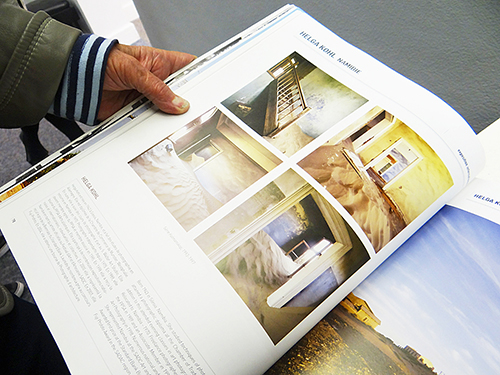
Fine art photographer Helga Kohl has been to Kolmanskop more times than she’s concerned with recalling.
She’s marvelled at how the light changes the character of the ghost town’s ruined rooms, crawled through tight spaces so as not to disrupt the sand cascading down a staircase and her stirring photographs of forgotten bathtubs and crumbling quarters have been displayed all over the world in galleries as near as Bamako and as grand as the Smithsonian.
On a crisp Tuesday evening in Windhoek, Kohl presents an art talk outlining the types of photography she has explored in a fine art career that has spanned over 40 years. The talk is a part of the Annual Visual Art Museum Programme (AVAMP) and just 15 guests gather in the National Art Gallery of Namibia’s lower showroom to hear of her birth in Poland in 1943, her immigration to West Germany and her auspicious arrival in Walvis Bay in 1971 where she met her husband, had two boys and began working in a photo shop.
Though images of Kohl’s Kolmanskop have earned praise in countries across the globe, during her presentation, the fine art photographer showcases a collection of her lesser known photographs after introducing seminal works by Alfred Stieglitz, Ansel Adams and Robert Mapplethorpe.
Describing herself as an unwavering analogue photographer intent on documenting indoor and outdoor scenes with only the help of daylight, Kohl foregoes filters, artificial lighting and digital effects in favour of waiting for the right light, understanding exposure and knowing how different film affects the look of the final photograph.
Though many of her images remain largely obscure to the Namibian public, Kohl’s 40 years of fine art photography have yielded much more than Kolmanskop. A lone Himba house in Koakoveld photographed in 1997, the Ministry of Finance jutting high into a blue sky, a late afternoon in Spitzkoppe in 1985 and an old San woman meditating over 30 years ago. Serene, impossibly thin, ancient and long gone.
In these images, as in her Kolmanskop collection, Kohl waits patiently until the magic hour.
To capture her now iconic images of Kolmanskop, she visited the ruins countless times for 16 years often just to sit, look and experience while trying to understand the lives of the people who lived during a faded time.
As the audience pores over slide after slide of her PowerPoint presentation, Kohl’s attention to detail is indisputable, her stunning skies and creative compositions created by lying patiently on her back beneath the Bank of Namibia or waiting for just the right cloud concentration below a building in Braamfontein to stir and stagger.
Though Kohl has photographed everything from landscapes to an anonymous dreadlocked man she encountered at a gas station in Zimbabwe during her honeymoon, her legacy remains Kolmanskop.
And what has become of it reduced Kohl to tears when she visited it two years ago to assess the viability of project propositioned by a French company who thought the ruins were worth exploring for a documentary.
Defaced with graffiti and marred by things moved, Kolmanskop no longer exists as the place that was featured as the Bamako Encounters’ official image displayed on every lamppost from the airport to the city as Kohl drove through Mali for the African Biennale of Photography in 2005.
This sad reality underscores the immense importance of Kohl’s contribution to Namibia’s photographic heritage with her images serving as the ghosts of a ghost town all the more ruined by man alongside nature.
Sheer frustration halts Kohl’s speech and opens a discussion that touches on Namibia’s need to support professional photographers who, much like Kohl, are sitting on hundreds of images imbued with the country’s identity through the ages which they cannot afford to print or exhibit… and which few people will ever see.
Though she has seldom exhibited in Namibia, Kohl has found fame in foreign lands and will be making her way back to the Bamako biennale in November, precisely 10 years after she first entered the competition and ensured Kolmanskop would be seen on flyers, posters and lampposts in Mali.
She holds Namibia high, even if it doesn’t do the same.
And before the evening ends, she thanks us for coming and treats us to a glass of wine bottled in 2009 with the hope that there’ll be more people next time.
In an age of information overload, Sunrise is The Namibian’s morning briefing, delivered at 6h00 from Monday to Friday. It offers a curated rundown of the most important stories from the past 24 hours – occasionally with a light, witty touch. It’s an essential way to stay informed. Subscribe and join our newsletter community.

The Namibian uses AI tools to assist with improved quality, accuracy and efficiency, while maintaining editorial oversight and journalistic integrity.
Stay informed with The Namibian – your source for credible journalism. Get in-depth reporting and opinions for
only N$85 a month. Invest in journalism, invest in democracy –
Subscribe Now!