The story of the Toyota Rush dates back to 1997 when the second generation Daihatsu Terios was introduced. In 2005, it was rebadged as the Rush.
Toyota, Daihatsu’s parent company, saw a niche it could fill and the Rush was born. It has since been made by Toyota Philippines and is created mainly for Indonesia, however, thanks to its charm, it has found a place in Europe, Africa, Australia, South America and is also sold in the Middle East.
The Rush holds a special place in Africa where it sold 500 units in South Africa within its first month of launching. We have not seen many on our Namibian roads, but we do know it’s just a matter of time as this is an SUV-loving country.
Classified as a mini sports SUV, the Rush competes against the likes of the Renault Duster, Haval H2, Ford Ecosport, Hyundai Creta and Honda BR-V. Segmenting the Rush is not easy as it seems to have a broad range of qualities and features which fall under multiple segments.
At first sight, the Rush struck me as a Rav-4, being a small SUV while reminding me of the tall Toyota Venture because of its high profile and ground clearance. The Rush has also been called a Fortuner ‘ultra light’ even though it doesn’t have the off-road prowess of its sibling. It’s basically a towering city car.
Looking at its detailed design and styling, it strongly resembles the compact Toyota Aygo because of the X-styled face. Compared to its siblings, the Rush is a rather simple car with design as it strongest point. Notable features include under-plates, roof rails and rugged bumpers.
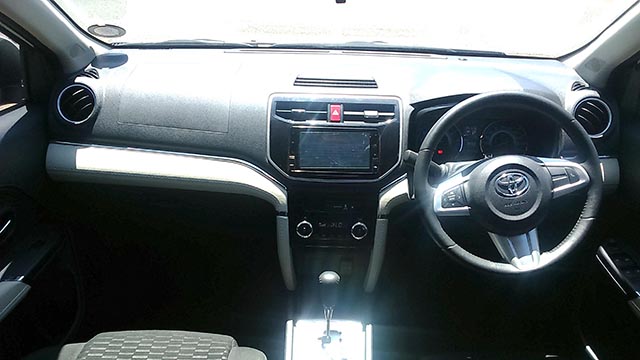
On the interior, the Rush is neat and symmetrical, taking on family styling reminiscent of the Corolla and CHR. Ergonomics are on point and it sports 28% more space than its closest competition. It’s a five-seater so large it accommodates two extra seats. Everything about its interior spells ‘ultra light’ as it’s a comfy car made with economy in mind. The overall fit and finish is quite impressive and simple. It dons piano-black and contrasting enamel white trim which gives it a premium feel.
The highlight of the cabin is undoubtedly the easy-to-operate touchscreen infotainment system with an instrument cluster displaying HD graphics with a cool blue motif, also offering an eco indicator. The Rush is packaged with infotainment features such as navigation, screen mirroring and rear-camera display. Sound related features include a six-speaker system, Bluetooth, USB, Apple Car Play and Android Auto.
The Rush is driven by a 1,5-litre 2NR-VE Dual VVT-i engine producing 77kW which translates to 102hp and 136Nm torque to the rear wheels via a four-speed automatic transmission (also available in five-speed manual). It shares an engine with the Avanza and Yaris; you would it would be too small for an SUV but the Rush makes up for it in its less weighty build, making its engine very lively, but it could admittedly use more power.
The Rush feels like a small car on the road, it’s composed thanks to Macpherson’s strut and rear link suspension set up. On gravel, its 220mm ride height comes in very handy. The lightweight frame can be a little worrisome for stability and handling and this is exacerbated by its rather tall stance, however you will have peace of mind to know it comes with a host of safety features such as vehicle stability, anti-lock breaking, hill assist, six airbags and smart entry system with park distance control and an immobiliser.
Overall, the Rush is well packaged, offering generous headroom both in front and at the rear for tall passengers and it comes with a rather tempting price tag. It grows on you, there’s just something about it I find appealing; perhaps because I loved the Toyota Venture.
In an age of information overload, Sunrise is The Namibian’s morning briefing, delivered at 6h00 from Monday to Friday. It offers a curated rundown of the most important stories from the past 24 hours – occasionally with a light, witty touch. It’s an essential way to stay informed. Subscribe and join our newsletter community.

The Namibian uses AI tools to assist with improved quality, accuracy and efficiency, while maintaining editorial oversight and journalistic integrity.
Stay informed with The Namibian – your source for credible journalism. Get in-depth reporting and opinions for
only N$85 a month. Invest in journalism, invest in democracy –
Subscribe Now!