



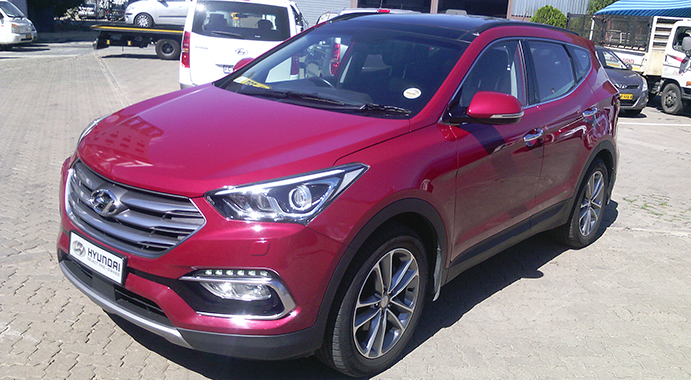
“Ready or not, here I come!” is what Hyundai is quietly saying. Unlike the hide and seek we used to play, this is a case of a market/industry invasion. Though they have been around for decades, they are ceasing to play second fiddle as they gun for premium status.
I quote from their vision: “Our engineers and designers need to deliver a top quality product with the perfect combination of efficiency, craftsmanship and engaging drive that is truly world-class. What you may not know is that Hyundai takes unprecedented steps, pushing beyond the old, conventional way of doing things to deliver new thinking, so we can provide you with new possibilities”.
This week we feature the Hyundai Santa Fe, the first SUV from Hyundai.
Positioned as seven-seat mid-sized crossover SUV (basically a five-door SUV), it was first introduced in 2000 and is currently in its third generation. Its competition includes the Honda CRV, Toyota Fortuner and the Nissan X Trail.
The Santa Fe got its name from the city of Santa Fe, New Mexico. This is a name I first received with mixed feelings but I grew to accept with time.
Perhaps the Santa Fe having a name originating from the Americas is what made it a huge success in the US and a cardinal building block to Hyundai’s success today (you know Americans love all things American, hence car names like Colorado, Yukon, Texas Silverado).
Even our previous Hyundai feature the Tucson was named after the city of Tucson, Arizona, being primarily built for the US market.
Few can resist what Hyundai is up to in terms design and styling, their up-market exodus is evident. Hyundai is packaging more features, refining their interiors and executing fresh designs based on their ‘Fluidic Sculpture’ design theme.
Fluidity in that it’s designed to be seamless like part of the air streaming over its body.
The Santa Fe Has a gaping mouth depicting modernity and it’s designed to take it into crossover territory. Its reduced height, increased length and styling cues such as the raised window line at the rear give it a dynamic, sporty and capable look.
I found the interior to be a bold and unique setting, similar to its Veloster sibling’s interior theme with emphasised shapes, it also has pronounced sweeping lines coming to meet almost at the AC off and on button near the centre console.
Just like for its Veloster sibling, its designers say this dash was sport motorbike inspired. Its general interior design theme has an Asian orientation, a bench mark set by Lexus.
The most notable interior features include a massive sunroof, a 12-way power driver’s seat with memory, heated steering wheel, heated ventilated front and second-row seats, dual zone climate control (front and rear), four 12-volt power outlets, a 115-volt outlet in the cargo area and a smart power lift gate.
For infotainment, features include: An eight-inch infotainment and navigation touch screen, USB slots, Bluetooth connectivity, a 12-speaker Infinity sound system, Blue Link-connecting to mobile and home devices, Android Auto and Apple CarPlay capability as standard.
In the engine bay of the Santa Fe is a 3,3-litre V-6 engine that generates 290 horsepower and 252 lbf-ft of torque. This direct-injected engine with variable valve timing is shared with the Kia Sorento (which is a superb machine).
It’s coupled with a six-speed automatic transmission. I found the accelerator pedal to have a very long range, it kept going deeper and deeper as it summoned more and more power. The Santa Fe does a vigorous 0 to 100km/h in 7,3 seconds.
Talking safety, the Santa Fe is packaged with: Autonomous emergency braking, with pedestrian detection (it uses a forward camera and radar sensors to detect rapidly closing speeds to the vehicle ahead or pedestrians in your path), blindspot warning, lane departure warning, rear cross-traffic alert, multi-view 360-degree camera, individual tire-pressure monitoring, adaptive cruise control (with stop-and-go functionality), parking sensors, swivelling HID xenon headlights as well as automatic high-beams (provides added convenience by automatically turning high beams on or off based on oncoming traffic).
The standard drive mode select system adjusts both throttle response and steering effort to match your preferred driving style. Select from three modes – eco, normal or sport – by simply pressing a button. It has a comfy supple ride through out and feels very stable and steady.
The Santa Fe seems to be an alternative which is more edgy. It’s a solid build with a refined, loaded interior and gives a comfy ride. If you want to catch your rivals off guard, get a Hyundai, especially a Santa Fe.
In an age of information overload, Sunrise is The Namibian’s morning briefing, delivered at 6h00 from Monday to Friday. It offers a curated rundown of the most important stories from the past 24 hours – occasionally with a light, witty touch. It’s an essential way to stay informed. Subscribe and join our newsletter community.

The Namibian uses AI tools to assist with improved quality, accuracy and efficiency, while maintaining editorial oversight and journalistic integrity.
Stay informed with The Namibian – your source for credible journalism. Get in-depth reporting and opinions for
only N$85 a month. Invest in journalism, invest in democracy –
Subscribe Now!