


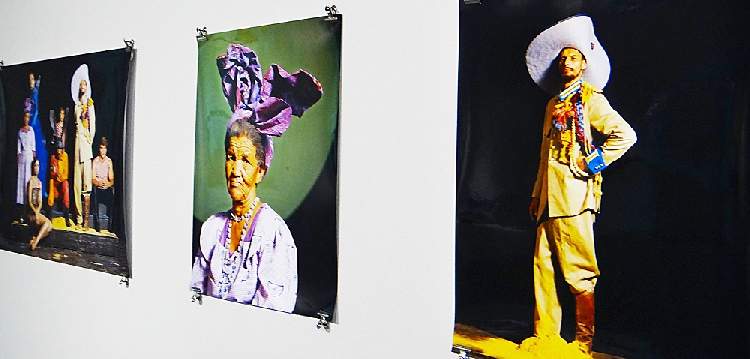
The graves have been grown over, some skulls have been returned but, over 100 years later, an artist exhibiting at the National Art Gallery of Namibia calls for reparations while another has designed ‘A White Guilt Offset Credit’ – a fictitious certificate by Diane Arce that acknowledges the reality of white guilt as a symptom of the need to fight racism, cultural appropriation and micro-aggressions worldwide.
Curated with German artist Spunk Seipel in response to a very difficult chapter of our history, ‘1884 – 1915: An Artistic Position’ is a collection of paintings, posters, prints, textiles, film, photographs and mixed media works which attempt to interrogate the reality and ramifications of the German colonial era in Namibia.
Featuring pieces by Namibian, German and other international artists, the exhibition presents a series of positions and statements that range from the blurred images of prominent German colonialists in Thomas Eller’s ‘The Rot Remains with Us, The Men are Gone’ to Nicola Brandt’s ‘Indifference’. A filmic exploration of the contrasting lives, memories and realities of two present day Namibians. One a Herero woman who passes Ovaherero and Nama mass graves on her way to work, the other an elderly German Namibian woman seemingly snug in her illusions about the Second World War .
With Hendrik Witbooi as a recurring character and a historical hero in the fight against colonialism, the exhibition presents various individuals, the colonialist least of who find themselves as Spunk Seipel drawings in the NAGN foyer over which visitors can write forgiveness, comments or vitriol while partaking in the verbal construction of a different kind of monument.
Not uniformly provocative, the exhibition also features the work of Tina Schönheit who presents such lucid statements as “we are far more complex than our complexion” in her display of enlarged negatives featuring a black and white couple who exist in a world far beyond Tuaovisua Katuuo’s ‘Otjitiro Otjindjandja’ (The Genocide) depicting a mass of bloodied, shackled and faceless Nama and Herero.
Though the exhibition does have one foot firmly in the past, Uuarika Tjiteere’s lino print of the Herero monument in Swakopmund Memorial Park Cemetery and Berlin Postkolonial’s attempts to have German street names changed from those of colonisers are heartening as is their push for the creation of a memorial to the Herero and Nama in Berlin.
Less so is an account by Matthias Beckman who went to a museum showcasing tribal African art in Germany, asked to see work from Namibia and was told that the guide had heard of Namibia before but was unsure if they were showing anything from the country. ‘Guilt’ by Oliver Ressler is equally disturbing as the artist presents a picture of Africa’s lesser foreign debt in comparison to the damages caused by colonialism and slavery on the continent which runs into the hundreds of trillions.
Equally edifying is ‘Empty Herero Dress’ by Velco Panofi and Nambahu Latina which displays a hanging Herero woman whose garments are patterned with emaciated Herero and Nama, German colonisers and Namibian heroes while twirling lightly in the upper gallery.
Essentially, an exhibition whose purpose is best articulated by Barbara Pirron’s ‘Blindfolded’ series which was created to depict a pervasive “blindness to uncomfortable realities,” ‘1885-1915: An Artistic Position’ features many more artists and will prove an informative hour for anyone interested in colonialism in retrospect and with regard to the residual.
In an age of information overload, Sunrise is The Namibian’s morning briefing, delivered at 6h00 from Monday to Friday. It offers a curated rundown of the most important stories from the past 24 hours – occasionally with a light, witty touch. It’s an essential way to stay informed. Subscribe and join our newsletter community.

The Namibian uses AI tools to assist with improved quality, accuracy and efficiency, while maintaining editorial oversight and journalistic integrity.
Stay informed with The Namibian – your source for credible journalism. Get in-depth reporting and opinions for
only N$85 a month. Invest in journalism, invest in democracy –
Subscribe Now!