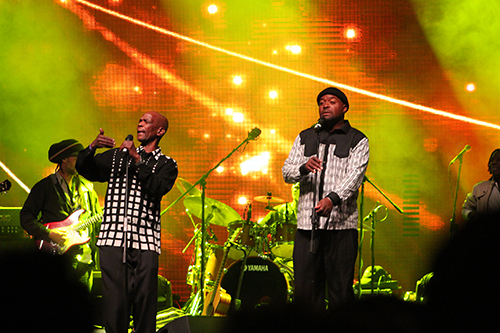
SOUTH African Afro-fusion group Stimela spoke to Conrad Angula of The Namibian last week before their performance at the Independence Stadium in Windhoek together with American soul sensation Trey Songz.
Stimela has a huge fan base in Namibia, as some of their songs became unofficial street anthems during the liberation struggle.
The message in your music was clear – you fought the old regime relentlessly. What is the message you are sending out now?
Africa’s heart is huge and awesome. Africa keeps giving and never wants to take centre stage. Now is the time for Africa to re-emerge with all its children singing from the same page, same song, same melody and with one voice.
There is a very big difference
between the days when you recorded ‘I Wanna Know’ and ‘Unfinished Story’.
As a band leader I was compelled to deliver on a promise we had made. We said we would be the voice of the voiceless. ‘I Wanna Know’ was written for ‘The Cannibals’ new vocalist Jacky Madalane.
How do you classify your music?
: Simplicity is the trick. We marry lyric to melody and complement that with raw energy, honesty and leadership support.
What makes Stimela tick?
What makes Stimela tick is the social commitment in utilising the arts as an instrument of social change; to transform society through performances and to interact in order to find solutions within the African agenda.
You seem to be together forever, holding onto a strong bond. I first got to hear about Stimela in the 1980s when you started off as a six-member group – The Cannibals. Why the name change?
Change is painful but worth the travel. 1978 dealt a sad blow to The Cannibals through the passing away of Jacob Mpharanyana. Radebe left The Cannibals with no lead singer, hence the formation of Stimela. Jabu Sibumbe used to be a dancer for The Cannibals, but he later joined the Mthunzini Girls from the Mavuthela label as a drummer and soon found himself joining the soul group The Movers. Isaac Mtshali was also a dancer for Jabavu Queens and graduated to drums after the formation of the Izintombi Zokhethelo, whose backing band was Amazimzimu (translated The Cannibals). We have been together for 48 years: Ray Phiri, Jabu Sibumbe and Isaac Mtshali. Llyod Lelosa came from the third generation of the Movers. We formed Stimela after a tour of The Cannibals and the Movers in 1980 and the journey began, backing any artist that needed a solid band for their recordings. That’s how Stimela came to be.
Ray, Isaac ‘Mnca’ Mtshali and you have come a very long way. How is your relationship off stage?
Very trying. Isaac is a traditionalist and I am a dreamer who dreams of all that’s good and bad and can back that up with progression, while he wants things to remain the same. He is that kind of person who preaches ‘why fix it if it is not broken’, and I go, ‘times are changing, you got to change with the times’. I love him to death. He is the sanity in a confused world.
Was Isaak Mtshali a drummer with The Movers and how is it like recording with Stimela as opposed to recording with David Thekwane?
:No, he has always been a session drummer and belonged to The Cannibals pre Stimela.
Is there any truth about what was written in the media that he (David) used to lock you up in the toilet when he was not happy with the way you conducted yourself inside the studio?
False. I never worked for David Thekwane. Jabu and Llyod heard the stories second hand from those who plied their trade with David Thekwane. The recording industry of those days was run like politics. You were not allowed to collaborate with the opposition.
What inspires Stimela’s music now?
Inspiration comes from all challenges facing our great continent Africa.
What is the song ‘Whisper in the Deep’ all about?
’Whisper In The Deep’ encourages honesty, boldness, dealing with fear of centuries, giving society an opportunity introspect; to speak up and not be afraid. ‘Is the sleep right in your eye? This is tasty food for rotten flies’…
Ray, how much influence did the Dorkey House have on your music career?
Dorkey House was for the genre-orientated musicians: We country pumpkins were looked down on as Jim-comes-to-Jo’burg types. I was never influenced by Dorkey House. Like I said, it was a space for Jo’burgers, not us country pumpkins. We knew where we belonged. Mbaqanga music was our thing; jazz or marabi involved too much hustle. Save for Soweto Soul Music circus in the 70s.
The song is so relevant in that every regime sans time quiver at the mention of Phinda Mzala speak up your mind don’t be afraid, awungitshele, Phinda Mzala – hahaha!
How big is the gap that was left by the passing away of Nana Coyote?
There’s no gap. If there was, we haven’t noticed it, though we celebrate his life and contribution. Songs are bigger than the individuals. It was very hard for us to accept his passing but who are we to complain? My day will come and all mysteries will abound. I am a great fool for all the opportunities afforded to me.