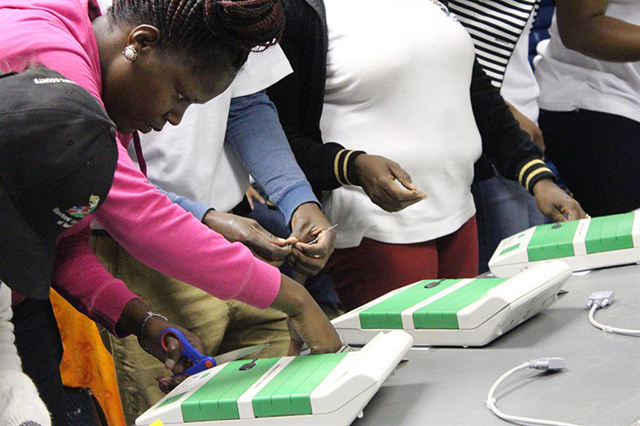
IN 2014, Namibia became the first country in Africa to use electronic voting machines in a national election.
An electronic voting machine (EVM), as its name suggests, is an electronic device used to cast, record and count votes during an election.
In Namibia, the EVM consists of a control unit which is connected to a ballot unit. Voters indicate their vote for a particular candidate or political party by pressing the green button beside their choice on the ballot unit. When the green button is pressed, a light beside the green button glows red to show that the voter’s choice has been recorded. The voter then presses the red “register” button at the bottom of the unit to complete the voting process.
When a voter casts his or her vote, this automatically locks the machine. The polling officer must press a button on the control unit to “open” the machine again for the next voter. This system ensures that each person only votes once.
The use of EVMs is authorised by the Electoral Act 5 of 2014. The law requires that the presiding officer for each polling station must make sure that the voting machines are cleared of any votes before the poll begins. The presiding officer must allow political party election agents and accredited observers to inspect the voting machines if they wish, and then close and seal them.
The Electoral Act also states that the use of EVMs must be accompanied by a verifiable paper trail for every vote cast by a voter, so that the tally of votes cast can be verified by a count of the paper trail – and that, in the event of a discrepancy between the results of the voting machines and the results of the paper trail, the paper trail results are given priority.
But these provisions on paper trails have not yet been brought into force – even though all the other provisions of the law were enacted almost five years ago.
How do paper trails work in other countries? There are different systems, but a common type of paper trail used internationally is a voter verifiable paper audit trail (VVPAT). This system allows the voter who has just registered a vote on an EVM to view a printed record of that vote through a transparent screen. The printed record remains visible for a few seconds, then drops into an enclosure so that it is securely retained for counting.
In some systems, if a voter sees through the window that the printed record of his or her vote does not match the button he or she pushed on the EVM, the voter can report this to the polling officials immediately so that a test vote can be tried on the machine. If the test indicates that there is indeed a problem, then use of that EVM will be discontinued.
In other systems, the paper records for specific polling places are counted if there is a dispute or some reason to doubt the accuracy of the electronic record. Alternatively, a spot check can be done by matching the electronic results with the paper record in a random selection of EVMs.
In these various ways, paper trails can reassure voters that their votes are being counted accurately, and provide an understandable mechanism for verification which can help ensure that the election results will be widely accepted.
In some countries, courts have found that paper trails are essential. For example, in 2009, Germany’s federal constitutional court held that the voting machines without paper trails violated the constitutional principle that elections must be transparent, which requires that voting machines must be safeguarded against potential manipulation or error through procedures which are understandable to the average citizen.
The court held that all the essential steps of an election should be subject to the possibility of public scrutiny, without any specialist knowledge. The decision did not rule out the use of EVMs, if the system provided for verification of an EVM against a record of votes “recorded in another way beside electronic storage”.
In 2013, the supreme court of India held that a paper trail is an indispensable requirement for free and fair elections, because voter confidence in the accuracy of the system can be achieved only in this manner.
The court stated, “EVMs with a VVPAT system ensure the accuracy of the voting system. With an intent to have fullest transparency in the system and to restore the confidence of the voters, it is necessary to set up EVMs with a VVPAT system”, in light of the immense importance of voting in a democratic system.
The court allowed paper trails to be phased in because of the cost involved, but in April this year ordered that the proportion of EVMs equipped with paper trails must be increased.
In 2014 the Namibian High Court dismissed a case challenging the use of EVMs without paper trails on the grounds that the applicants did not present evidence to support their concerns. The court stated that it accepted that the right to vote has two components: the right to cast a vote on the day of the elections, and the right to have that vote recorded and counted by election officials.
But the question whether EVMs without a paper trail could meet both those requirements was a question of fact which the court had to determine solely on the facts placed before it in the papers. It found that the applicants had made speculative and sweeping allegations, including broad allegations of election fraud and rigging without any factual support.
In contrast, the government filed a comprehensive affidavit from an expert in the field which dispelled the concerns raised by the applicants. Since this was solely a factual finding, it does not close the door to future challenges regarding the use of EVMs without paper trails if better evidence is presented to support the need for them.
The Electoral Institute for Sustainable Democracy in Africa observed the use of Namibia’s EVMs in the 2014 elections and reported that, given that Namibian EVMs lack VVPAT capability, the only assurance that EVMs record and tally votes accurately is the pre-poll test conducted immediately before the voting begins.
But, since the EVMs do not transmit or receive any signal, they are immune from hacking – so it is fair to assume that, following a successful pre-poll test, they will continue to record votes accurately. Nevertheless, this observer group recommended that Namibia should introduce a VVPAT component to the EVMs “in order to improve transparency and increase public trust in the system”.
The Electoral Commission of Namibia recently postponed its planned “hacking challenge” in which it intends to allow political parties to try their hand at tampering with randomly selected EVMs, in an attempt to put to rest fears on this score. This event, originally scheduled for 18 July, was postponed at the request of political parties who wanted more time to prepare.
This demonstration is a commendable idea, but no replacement for the introduction of a paper trail which can be always available for a verification through methods which do not require computer skills or expertise.
The ECN has an obligation to ensure the conduct of credible elections and as a result would not allow for the implementation of the VVPAT devices given the current recoverable and non-recoverable errors that were noted during the use of this technology at the time the consideration was made.
Firstly, there are two types of errors shown on VVPAT Status Display Unit (VSDU), namely the recoverable battery related error which, if it occurs, requires battery replacement without opening of the VVPAT section. There are, however, non-recoverable printer errors which require that the entire VVPAT component be replaced. In the Indian experience, the credibility of EVMs were compromised as close to 5% of the VVPAT malfunctioned during a pilot phase of the election process.
This scenario would have huge implications for our election results with potentially devastating legal and political consequences.
Other problems associated with the VVPAT technology relate to e.g. a VVPAT paper jam, which could compromise the secrecy of the vote while another scenario is the VVPAT not communicating with the EVM.
* This article is part of a series on election issues made possible by support from the Hanns Seidel Foundation.