




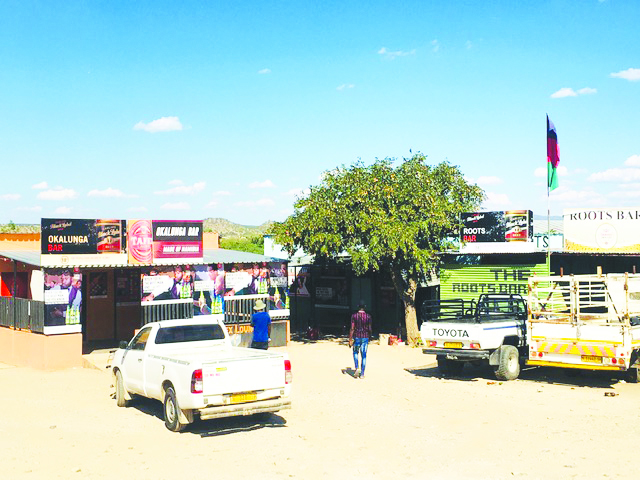
OPUWO, a town with 20 000 people and known as one of the poorest in the country, is drowning in liquor as bars continue to pop up at a fast pace.
The town’s main street, Mbumbiazo Muharukua Avenue which covers a distance of 2,39 kilometres, has at least 16 bars.
According to the National Planning Commission’s 2011 poverty report, Opuwo had a 44,1% poverty rate. Local media reported last year that there are 41 licensed liquor establishments along the three main streets of Opuwo, all falling within a three-kilometre radius.
The town has a low employment rate with education,the retail sector and police force being the dominant workforce.
Regional police commander for Kunene region James Nderura was recently reported as saying every second house at Opuwo is an alcohol outlet, hence the alcohol abuse in the town is difficult to control.
Nderura told The Namibian that alcohol consumption at Opuwo is high, especially among the youth.
“However, the alcohol consumption does not always contribute to the crimes in the town,” Nderura said.
The mayor for Opuwo, Rosa Mbinge ,also told The Namibian that the town has stopped licensing liquor outlets because they are too many for such a small population. Unlicensed outlets have, however, mushroomed and remain a big challenge.
“Council passed a resolution not to grant licences to new liquor outlets in the form of a bar/shebeen,” Mbinge said.
She said alcohol consumption is a national crisis and leads to many problems such as gender-based violence, accidents and robberies.
With the high number of alcohol outlets, recreational facilities are non-existent as there is only one student café in the town.
Mbinge added that the btown council offers free Wi-Fi at the student café – to those applying for NSFAF aid and to other tertiary institutions, or completing their theses.
She added that spending time at the café keeps the youth busy and away from other distractions.
Most locals believe alcohol abuse is high at Opuwo because there are no institutions of higher learning and when students fail Grade 10 or 12, they turn to alcohol as they have nothing else to do.
Parents cannot afford to send children to other towns for education, so these children remain at home and turn to alcohol. There is only one vocational training centre, the Community Skills Development Centre (Cosdec) and a Namibian College of Open Learning (Namcol) centre.
A resident of Opuwo, Nakale Tekla, said when there is a new development in the town it is a new bar.
“There are so many bars in this place and how will it grow if the entire youth is trapped in a town filled with alcohol?” Nakale said.
Another Opuwo resident, Tjitiuavi Tjairovandu, said that the rising number of bars has always been an issue for years.
He said most Opuwo residents’ lives are centred on alcohol. One wakes up, goes to bars until it is time to go home, then they repeat the process the next day.
“If something is not done about the number of bars and shebeens at Opuwo, I fear for the future of my town,” Tjarirovandu said.
According to the Opuwo Town Council, there are 38 licenced bars in the town.