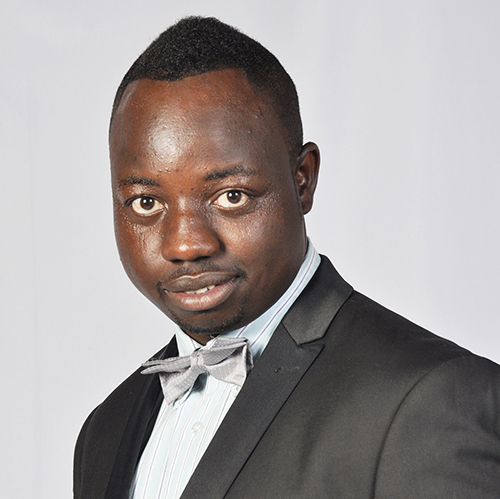
Mesias Alfeus [MA], a financial mathematician from Onamutai village in northern Namibia, says mathematics is a formal language, and agrees with a famous British statistician that all models are wrong, but some are useful. Alfeus shares his career journey with Lazarus Amukeshe [LA]
I was born at Onamutai village, in northern Namibia, where I also attended primary school. Like many, I had some time out of school taking care of my grandfather’s livestock, but was later able to continue my school career. I matriculated at Mweshipandeka High School and won the overall prize for the best pupil in higher level mathematics that year.
I then received a scholarship from the Petro Fund to study engineering at the Polytechnic of Namibia (now the Namibia University of Science and Technology). However, I felt I was mathematically starved. My prayers were answered when I met Veston Malango, chief executive officer of the Chamber of Mines. He helped me secure a scholarship from the Mineral Development Fund to study pure and applied mathematics.
I was accepted by Stellenbosch University, which after few weeks of classes deregistered me because my English was poor. I was traumatised, but never gave up. I came back to Namibia and pursued the University of Namibia (Unam). I was eventually admitted for a Bachelor of Science with mathematics and physics.
I received numerous academic awards at Unam, including dean and faculty awards. In my final year, the abstract of my honours thesis got accepted at the III Jean Conference on approximation theory held in Ubeda, Spain, where I had the opportunity to present a talk on my thesis. I got remarkable feedback from the scientific committee.
After Unam, I received a sponsorship from Namfisa and went to Stellenbosch University for my honours and master’s degrees, where I also received numerous merit awards. I worked for Namfisa for a short while, and lectured part-time at Unam.
In 2016, I was awarded an international research scholarship by the Australian government research training programme and went to Sydney, Australia, to do my Doctor of Philosophy in quantitative finance at the University of Technology Sydney (UTS) Business School.
I was a casual academic and research associate and enrolled in leadership programmes, and I was selected as a PhD student leader for Finance Discipline Group. I completed my PhD within a record time. My thesis was on stochastic modelling of new phenomena in financial markets, and was completed with examiners’ recommendations as the best thesis in finance.
I received a lecturer position at the University of Wollongong, which is a rare opportunity for someone without post-doctoral experience in Australia.
I got married last year and left Australia for South Africa. I was fortunate enough to be appointed in a research position in the department of the African Institute for Financial Markets and Risk Management (AIFMRM) at the University of Cape Town.
Six months along the line, I was appointed permanently by Stellenbosch University as a lecturer in financial risk management.
I regard this offer as a top-notch opportunity, and I am looking forward to an amazing academic journey.
I was drawn to financial mathematics because of my keenness to explore and exploit the usefulness of mathematics in modern finance. I wanted to invest in the knowledge of applying mathematics to something that will have enormous long-lasting practical implications to the developing Namibian financial market. I was fully convinced that financial mathematics is the cream of the crop.
It is a branch of applied mathematics that applies stochastics and probability theories to predict uncertain financial market events, pricing risk and the valuation of contracts contingent on the uncertain market future.
Mathematics is a formal language which requires formal approaches. It is a cumulative subject and to do it well, one needs to understand the underlying definitions, not to jump the gun. Many people find mathematics difficult because they don’t grasp important core definitions.
MA: I was doing post-doctoral research at AIFMRM. My research was based on developing stochastic models under uncertain market volatility dynamics. These models are applicable to the pricing of contracts in high-risk environments, and to forecast volatility during market stress conditions.
My love for maths started way back in the village when I used to play a game called Owela womanghete with my great-grandmother. I used to be good at it and my grandmother and teachers said I would be good at maths.
As a result, I set up a challenge for myself to pursue mathematics with rigour. My approach comes with incredible enthusiasm, passion and love.
Through this I received my nickname, ‘Math Lion’ in high school. After my bachelor’s degree at Unam, I found finance to be an area that requires rich and deep mathematics.
Moreover, due to the scarcity of financial mathematics experts in Namibia at the time, I knew I was going to study a field that is critical for Namibia’s march to prosperity.
Research collaboration, and spending time with students. I also enjoy discovering new mathematics with practical applications.