



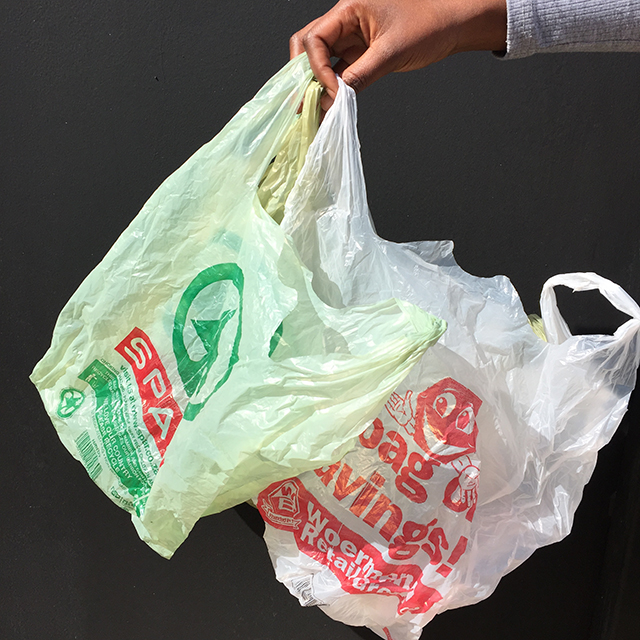
THE government will make roughly N$14 million per annum, once the environmental levy on plastic bags is gazetted.
Chief public relations officer at the finance ministry Tonateni Shidhudhu said these were the findings of a study conducted by the Environmental Investment Fund (EIF) in 2018.
Speaking to The Namibian last Thursday, Shidhudhu said the plastic bag levy is a way of protecting the environment through discouraging customers from using plastic bags.
“This N$14 million can be made in the first year of gazetting the levy. But once it is fully accepted, the amount will be reduced as customers will take heed of the call to protect the environment. The intention with this levy is not to generate money, but rather to campaign for the good of the environment,” he stated.
Retailers have already started charging for plastic bags, despite the plastic bag levy not having been gazetted yet. The finance ministry is set to gazette the levy on 1 August. The retailers started charging for plastic bags, after finance minister Calle Schlettwein tabled the 2019 budget in March.
The chief PR officer said the retailers are not necessarily acting illegally, and the ministry is not calling on these retailers to stop charging the levy. But the government is not yet receiving the money.
In a statement last Wednesday, Shidhudhu said: “Although the finance ministry welcomes initiatives by business outlets to curb the pollution of the environment, we wish to inform the nation that the money currently being charged by retailers is not yet part of the plastic levy that the government proposed. This means the money that customers pay for plastic bags becomes part of the individual businesses’ incomes.”
He said the decision to charge the levy was taken by Cabinet, and the proceeds will be channelled to the EIF for reinvestment in improved waste management.
The implementation of this levy will be done through the Customs and Excise Act No 20 of 1998, which is administered by the finance ministry.
“This is the same act that was used to impose levies on carbon dioxide emissions, tyres, and incandescent bulbs. The Ministry of Finance, the Ministry of Environment and Tourism and the EIF have been working out modalities on the income consolidation policy to facilitate the effectiveness of the levies,” Shidhudhu noted.
He further said the preparation to gazette these new levies has been completed, and will be done on 1 August. But it will only come into operation after tabling in the National Assembly. Meanwhile, the EIF has received N$60 000 from Pupkewitz Megabuild and its subsidiary, Kaap Agri Namibia, which voluntarily introduced the Break-Free-from-Plastic campaign in December 2018 and charged 50 cents for a bag.
As from 1 June 2019, Pick n Pay Namibia – a subsidiary of the Ohlthaver & List (O&L) Group, started charging 50 cents per grocery plastic bag at all its stores across the country. However, the funds collected in close to the two months that the campaign has been in existence has not yet reached the government’s coffers.
Pick n Pay Namibia marketing manager Victoria Möller at the time said: “Plastic has a critical purpose in various industries. It is thus not the plastic as such that is the problem, but rather the behaviour of us humans with the use and treatment of plastic that has led to the unfortunate impact it has on the planet today.
“Charging for plastic carrier bags has been proven to increase awareness among users, and it is therefore important for Pick n Pay Namibia, as a caring Namibian entity, to play our part in raising awareness and sustaining our environment.” Other big retailers in the capital like Checkers/Shoprite also charge for the plastic bags already.