




Ministry of Education, Innovation, Youth, Sport, Arts and Culture executive director Edda Bohn has denied claims that Auas Primary School removed Khoekhoegowab as a subject.
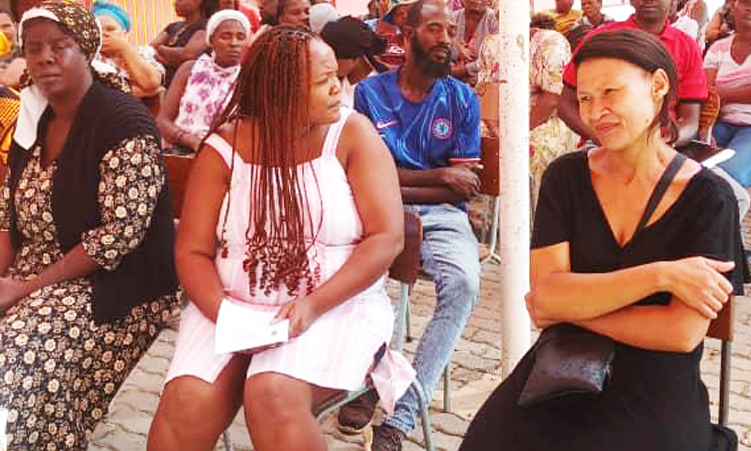
This follows protests yesterday morning from the Dolam community, which handed over a petition alleging the “inhumane treatment and erasure” of the Khoekhoegowab language at the school.
“On behalf of the Ministry of Education, Innovation, Youth, Sport, Arts and Culture, I am happy to say yes, our minister met the aggrieved community members at Auas Primary School and we listened to their petition as well as received that in good faith.
“Regarding your question on whether or not I can confirm that Khoekhoegowab is being removed, I must in fact say this is not true. Khoekhoegowab is being taught at the school and is used as the predominant language alongside Afrikaans,” she says.
A petition, dated 22 April and addressed to education minister Sanet Steenkamp, alleged systemic neglect and discrimination against minority languages in the education system.
The petition argued that the removal of Khoekhoegowab classes, while a logistical decision, is a violation of cultural and constitutional rights.
It expressed frustration at what it describes as a continued pattern of structural exclusion masked by claims of national unity.
“Let’s be clear on one thing, what we have isn’t unity, it’s uniformity enforced through silence. It is the comfort of numerical dominance mistaken for moral authority. The dismissal of minority realities as ‘perception’ or ‘tribal bitterness’ is not objectivity, it’s erasure,” the petition read.
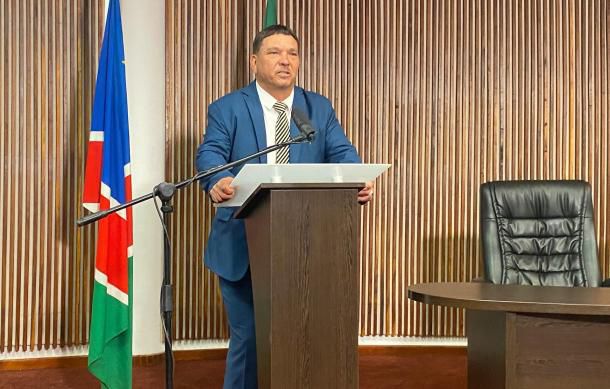
Speaking at the handover, Steenkamp says the presence of community members and parents at the petition handover shows their dedication to the education of their children.
She states that some parents learned about the discontent of parents over the removal of Khoekhoegowab on social media.
“I wish to acknowledge as said that many of you have taken leave to be a part of the petition handover because of the importance that you attach to your mother tongue,” Steenkamp says. The document also outlined not only the legal basis for their claims, referencing the Namibian Constitution and the Basic Education Act, but also the emotional and cultural toll of language erasure.
The petition emphasised that language is not just a tool for communication but a critical aspect of identity and heritage.
“We are not asking for space or your permission. We are claiming our national space with truth as our compass and justice as our direction,” the petition read.
Detailed grievances include allegations of misconduct and unilateral decisions made by Auas Primary School principal Toini Nauyoma. She is accused of removing Khoekhoegowab classes without proper consultations and replacing them with Oshikwanyama classes, repeating a similar pattern from her time at Groot Aub Primary School.
“It is an undeniable fact that Auas Primary School finds itself in an area where the majority of the people speak Khoekhoegowab. It is also a grounded fact that Ms Nauyoma removed Khoekhoegowab from pre-primary
classes and replaced it with Oshikwanyama, applying the exact modus operandi she did at Groot Aub Primary School,” the petition read. Community members also accuse Nauyoma of discriminatory remarks and showing favouritism in hiring, alleging that teachers paid for positions and that many hires were from her village. They claim this points to a broader trend of nepotism, tribal discrimination, and victimisation within the school system.
“It is a fact that in January, children of Damara/Nama backgrounds were called useless and with no future by Ms Nauyoma,” the petition read.
Moreover, the petition called for urgent corrective actions. Among the demands are an independent investigation into hiring practices, freezing of recently advertised Oshikwanyama posts, and the immediate removal of Nauyoma while investigations are underway.
Concerned community members also request transparency through documentation of parent meetings and language policy decisions.
“Where there is no interest in Khoekhoegowab at schools, we demand to see reports of evaluations and monitoring,” the petition noted.
It highlighted the vital role of indigenous languages in fostering self-identity and academic success among pupils.
It argued that losing one’s native language results in the extinction of cultural identity and detachment from one’s heritage.
“We will not surrender our language to anyone, for roots are to be grounded deep and firm to keep a tree alive for years,” the petition read.
As part of their next steps, the petitioners are calling for a nationwide boycott on 5 May, urging all stakeholders to mobilise and demand accountability from the education ministry. They have also attached documents supporting their claims, including letters from affected schools and endorsements from traditional and student bodies.
“We demand that the matter be treated as an urgent concern,” the petition noted. It reflected a broader concern that Namibia’s education system may be failing its minority communities by not upholding the constitutional and legislative guarantees of cultural and linguistic diversity.