




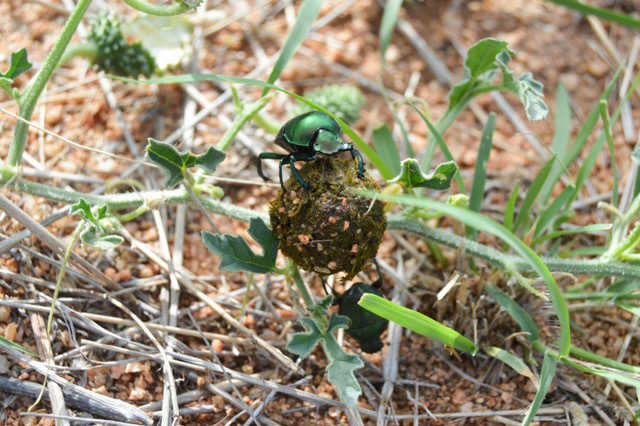
A NAMIBIAN scientist is investigating the impact of climate change in Namibia through a study of dung beetles that have evolved to become highly sensitive, and underrated, ecosystem watchdogs.
Project leader Heather UJ Nependa is conducting the research with the help of funding from the Nedbank Go Green Fund.
Nependa, who is studying for a masters degree in entomology at the University of Stellenbosch in South Africa, describes dung beetles as a “robust detector species” that could help Namibians better understand the challenges faced by the country’s already fragile ecosystems and landscapes as a result of climate change.
She said while many are put off by dung beetles for obvious reasons, they should be appreciated more for the instrumental role they play in healthy landscapes and their ability to help scientists answer important environmental questions.
“Though their lifestyles are strange and maybe a little nauseating, the work they do is crucial to the function of ecosystems,” Nependa said.
She added that the Nedbank Go Green Funding was the lifeline of a project few wanted to touch. “It is difficult to secure funding for a project like this that does not focus on a charismatic and appealing species, however, thanks to the Nedbank Go Green Fund and their commitment to sustainable development and an overall holistic view on conservation, I received funding,” she said. With the guidance of her lecturers in the entomology department, she chose to focus her project on dung beetles because of their close links to many mammal species and savanna landscapes.
“They are an environmentally sensitive species and are highly affected by plant density and diversity, and also importantly, to dung resources.”
Consequently this means they give an indication of habitat quality and how environmental change is impacting landscapes.
Furthermore, changes to their diversity and abundance could affect overall ecosystem health in a landscape “which is a cause for concern”, Nependa said.
She added that apart from measuring the impact of climate change, studying dung beetles could also be a good way to measure whether current conservation efforts are effective.
“Each day, the animal kingdom produces roughly enough dung to match the volume of water pouring over the Victoria Falls, meaning that without the work of dung beetles the planet would be literally covered in poop. Besides clearing this dung, the actions of these creatures have considerable ecological importance,” Nependa pointed out.
The primary function of the dung beetle is to disperse seeds, which ensures the growth of important forage for other animals.
The seed dispersal role of dung beetles is so important, Nependa says, that one plant (Ceratocaryum argenteum) evolved smelly seeds to trick dung beetles into burying them. Dung also contains excellent nutrients, which when buried by the beetles, acts as an important soil fertiliser for plant growth.
Nependa referred to a recent study in the United Kingdom that estimated the value for the work dung beetles do to clear British pastures and fertilising soil as amounting to 370 million pounds sterling per year.
In Africa, their astounding diversity is underlined by the amount of species, 5 700, found on the continent.
“What is even more remarkable and strange, is their preoccupation with excrements,” Nependa added.A single elephant dropping can attract up to 4 000 dung beetles within 15 minutes.
Dung beetles operate in three types, namely “rollers, tunnellers and dwellers”.
Rollers shape dung into balls and roll them away from the dung pile, which they then bury and later use to lay eggs in.
Tunnellers “dive right into the dung pile”, usually in male-female teams and dig a tunnel beneath the pile. The female beetle then stays in the tunnel, processing the dung that is delivered by the male who scurries to and fro.
Dwellers, on the other hand, “simply live in the dung pile”. Female dwellers lay their eggs there and when their young hatch they “blissfully munch away on the food that surrounds them,” she explained.
Nependa’s project, titled ‘Dung beetles as indicators of ecological disturbance in Namibia across a resource and land-use gradient’ is aimed at chiefly highlighting the importance of “how delicate our ecosystems are and how the disruption of one thing can permeate through entire ecosystems to all Namibians.”
In order to obtain those answers, the project is exploring and evaluating the effects of land-use changes, which require comparing a natural landscape to modified areas such as farms, by analysing dung beetle diversity and abundances.
A higher species diversity indicates a more stable and intact landscape compared to low species diversity.
Within Nedbank there is a broad consensus on the support of environmental initiatives, such as the Go Green Fund.
“The main aim of the study is therefore to determine whether there truly are huge, deleterious differences between these two landscapes or if they are being equally affected by anthropogenic threats.” To date, only few studies have looked at dung beetles and their overall status, diversity and ecology in Namibia and as a result Nependa’s work has already begun to improve on the scarce knowledge of the insects in Namibia.
Specimens collected to date have unveiled a few species that were previously not thought to be found in Namibia, which has lent the project added taxonomic importance for dung beetle ecology in southern Africa.
Nependa added that the results of her Nedbank Go Green funded project so far have shown a slight loss of species on the farm sites that were sampled, compared to the reserves sampled.