




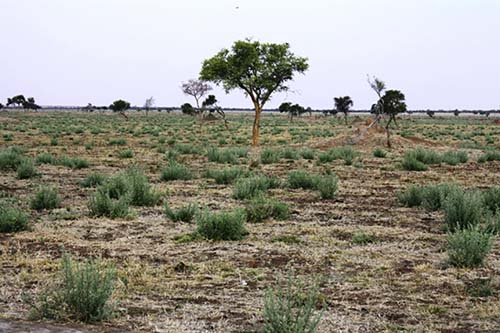
AXEL ROTHAUGESOIL – APPLIED arboricides containing the active ingredients tebuthiurone and bromacil are applied to the soil, washed into the root zone of plants by rain, taken up by roots to circulate inside the plant and kill it.
They are easy to use but unselective as they are absorbed by any plant root they come in contact with and unfortunately kill a lot of beneficial woody plants too.
Placement of poison and dosage (how much) is critical in the use of soil-applied arboricides.
Most woody plants have wide-ranging underground root systems. The roots of many different plants are found in the same space under the ground. Scientists speak of the “underground forests of African savannas”.
Apply poison to one spot and it will be taken up by many different woody plants. Thus, even if arboricides are carefully placed under just one target plant, they still poison many other plants too. If too much poison is applied under the target plant (over-dosing), enough poison is left to be taken up by other plants to kill them too.
Therefore, soil-applied arboricides should only be used where there are dense stands of a single encroaching species, for example mono-stands in which few other woody plants than the encroaching species occur.
The more diversely wooded an environment is, the less appropriate it is to use soil-absorbed arboricides. Don’t use soil-applied arboricides in a diverse stand of woody plants containing many different species or within 30-50 m of a big tree that has to be preserved, e.g. a camelthorn or shepherd’s tree.
Encroaching bushes closer than 40 m to the valuable tree have to be killed off in a different manner, for example by foliar spraying or chopping.
Soil-applied arboricides are commonly available as pellets that are thrown under target bushes or into a thicket, making them convenient to use. Heavy rain can dislodge the pellets and wash them sideways, causing off-target plants to be poisoned (see picture). So pelleted arboricides should be avoided.
Soil-applied arboricides also come in concentrated solutions or soluble powders that have to be diluted to the appropriate concentration before use.
The diluted liquid is then sprayed with a dose gun-like apparatus under targeted bushes. The liquid is absorbed by the soil and stays in place despite heavy rains. It is brightly coloured or can be dyed to make it easy to see which plants have been treated and which ones not, making supervision simple.
In my experience, it is better to use liquid rather than pelleted soil-applied arboricides.
A good example of how not to use soil-applied arboricides can be seen on the Linyanti road, 8 km west of Katima Mulilo.
Beautiful and valuable Zambezi hardwood trees like kiaat (mukwa) and teak trees (mukusi) close and far from the road died because an excess of pelleted arboricide was strewn in the corridor of the quarantine farm to clear the corridor of woody plants.
Big trees have an extensive root system and obviously picked up the poison put in the corridor next to the road. The huge tree skeletons are a stark reminder of man’s power to, unthinkingly, do irreparable damage to the environment.
The use of soil-applied arboricides by hand is problematic but to strew them across the landscape from a small aeroplanes is unforgiveable.
Aerial application of arboricides is unselective and dosage is unresponsive to small-scale biological variations on the ground.
The result often is an unmitigated disaster with all trees except the tolerant witgat (shepherd’s tree) being killed off over thousands of hectares. What took nature hundreds of years to erect, we erase in an hour of flying.
The savanna is left with hardly any woody cover at all, no structure, without stability and very little resilience against natural shocks. Just take the tar road to Gobabis and witness the total destruction of valuable riverine forest at the foot of the last hill before Witvlei.
Most often, nature’s response is to overgrow the bare area with another woody pioneer or noxious weed such as the blue stink bush, causing worse grazing conditions than before.
In my view, aerial application of arboricides should not be allowed unless preceded by an environmental impact study that ascertains that there is no better alternative.
The decision to use aerial application of arboricides should certainly not be left to individual land users as it results in a crime against nature which affects us all. I also wonder how long we can uphold the image of Namibia’s beef being ‘Nature’s Reserve’ if we spray the feed source of cattle with arboricides from the air.