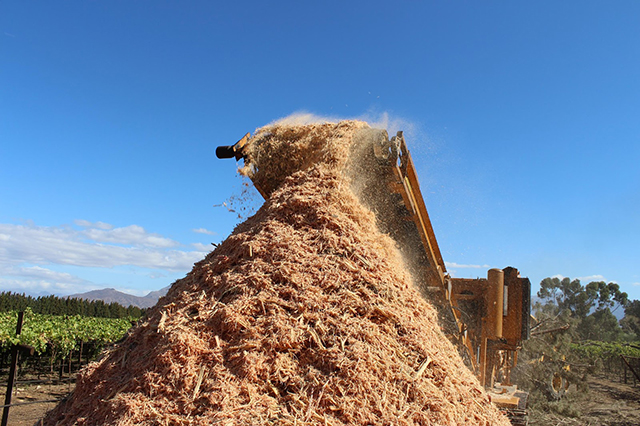
THE use of encroaching bush to manufacture animal feed has situated itself as a strong contender for efforts towards environmental sustainability in a drought-stricken Namibia.
This was revealed during the Namibia Biomass Technology Expo held at the Otjiwa Safari Lodge near Otjiwarongo last week, during which exhibitors demonstrated and discussed how to turn the widespread problem of bush encroachment into socio-economic opportunities.
Bush encroachment is an invasion or thickening of undesired woody species, which can suppress the growth of palatable grasses.
This was explained in a presentation by University of Namibia (Unam) researcher María Luisa de la Puerta Fernández, who positions the phenomenon as a major risk to food security.
Fernández coordinates the Bush-to-Feed project at the university, which aims to optimise bush-based feed production.
“Bush encroachment also decreases biodiversity and the carrying capacity of the ecosystem, with all the economic losses that this entails,” she observed.
According to her, bush-based feed has proven to be not only a drought relief feed, but also a more affordable production ration.
Africa Biomass representative, Barend van der Westhuizen echoed this sentiment, touting it as the future. At the expo, he demonstrated the use of an Agrifeed machine intended to upscale operations, and produce ready-to-feed roughage.
“Bush to feed is the way to go. A machine like this can substantially upscale operations. It has a throughput of three to seven tonnes,” he noted.
Recently, a policy recommendation was made by the high-level panel on the Namibian economy (HLPNE) to permit the registration of bush feed as animal feed.
During the economic growth summit earlier this month, the panel recommended that the government should agree to issue bush harvesting permits to communal farmers, and provide mechanisms to open up the harvesting of charcoal in communal areas.
The managing director of Pupkewitz Megatech, Morne Nell, said in his presentation at the expo that the failure to commercialise bush-based animal feed poses a challenge to the country, as there is no opportunity for communal bush feed producers to contribute their product to the economy.
He explained that the bush-based animal feed produced by most communal farmers does not meet the ministry of agriculture’s criteria.
“Pupkewitz Megabuild and Kaap Agri support “on-farm boskos systems” to produce animal feed products and fertiliser. Once legalised, Kaap Agri can potentially look at selling locally produced boskos,” he added.
Exhibitors share the sentiment that bush-to-feed production will provide the necessary economic opportunities for farmers and Namibia as a whole, as well as tackle the environmental issue of bush encroachment.
“Considering the impact of global warming, our current drought and the fact that Namibia loses approximately 3% of its grazing land to bush encroachment each year, it was critical to legalise ‘boskos’ and give it a commercial value, and at the same time free up grazing land,” Nell said.
Furthermore, encroaching bush can also be used to establish biomass-to-energy power plants, which, according to MJ de Wet of the Africa Biomass Company, would save Namibia billions of dollars.
“[It] would not only save billions of dollars by reducing the importation of electricity; it would create thousands of new jobs, and could turn the cattle and beef industry around, while restoring the savannah, biodiversity and groundwater resources,” he noted.
De Wet said Namibian biomass can successfully compete with the fossil coal delivered to the country, and would be less environmentally detrimental.
“It is a renewable fuel with less harmful emissions, and clean ash which can be returned to the soil as part of a savannah restoration programme,” he stated.
Furthermore, he explained that the country would save billions in electricity and coal imports while generating base-load electricity on a continuous, uninterrupted basis over decades.